


 admin
admin How to Get a Divorce Without a Lawyer: A Comprehensive Guide to Pro Se Divorce
Ending a marriage is one of the most stressful life events a person can experience, often compounded by the fear of exorbitant legal fees. However, for couples who have mutually agreed to separate, getting a divorce without a lawyer—legally known as proceeding pro se—is a practical and increasingly common option. Representing yourself can save thousands of dollars and allow you to maintain control over the timeline of your separation. While the legal system can appear complex, it is navigable for those who are organized, detailed-oriented, and willing to learn the specific procedures of their local court system.
Determine if You Qualify for an Uncontested Divorce
The most critical prerequisite for a DIY divorce is that the separation must be uncontested. This means that you and your spouse agree on absolutely every issue involved in ending the marriage. This includes the division of all property and debts, spousal support (alimony), child custody, and child support. If there is even a single disagreement that you cannot resolve on your own, the case is considered contested. Contested divorces generally require legal strategy and advocacy, making them unsuitable for self-representation. If you can communicate effectively and reach a consensus, you are a prime candidate for a pro se divorce.
Verify Residency and Jurisdiction Requirements
Before you fill out a single form, you must verify that you meet the residency requirements for the state and county where you intend to file. Jurisdiction is strictly enforced; if you file in the wrong location, your case will be dismissed, and you will lose your filing fees. Some states require you to have lived there for as little as six weeks, while others require residency of six months to a year. Additionally, you typically must file in the county where either you or your spouse currently resides. Check your local court website for these specific jurisdictional rules.
Gather Necessary Financial Documents
A successful divorce requires complete financial transparency. Before starting the paperwork, compile all relevant financial documents. This includes recent tax returns, pay stubs, bank account statements, credit card bills, mortgage statements, and retirement account balances. You will also need deeds to real estate and titles for vehicles. Having this information organized beforehand will make filling out the mandatory financial disclosure forms significantly easier and ensures that your eventual settlement agreement is based on accurate data.
Locate and Download the Correct Legal Forms
Every state has its own specific set of divorce forms. You generally cannot use a generic form found on a random website. The most reliable source for these documents is the official website of your state’s judicial branch or your local county clerk’s office. Look for “family law” or “dissolution of marriage” packets. Be careful to select the packet that matches your situation—forms for couples with minor children differ significantly from those for couples without children. Using the wrong forms can lead to procedural delays or rejection by the court clerk.
Filing the Petition for Dissolution of Marriage
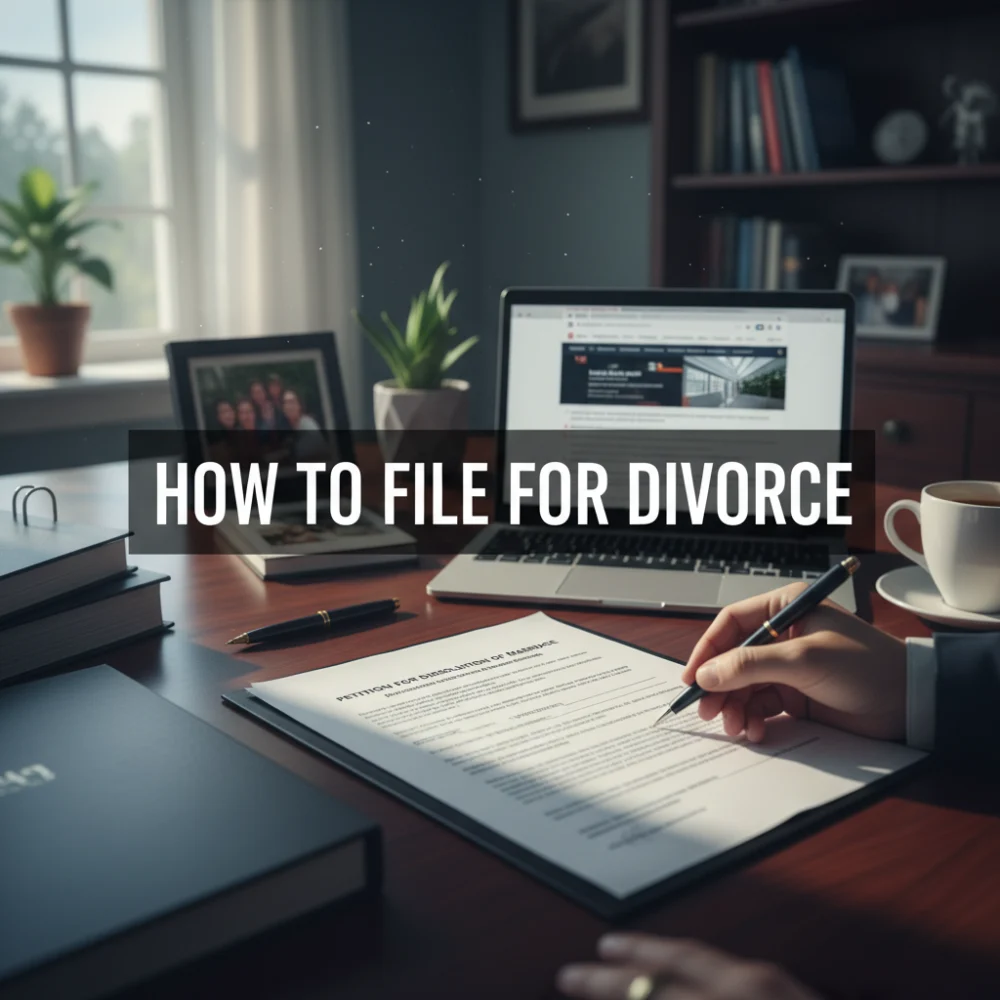
The legal process formally begins when you file the Petition for Dissolution of Marriage (sometimes called a Complaint). The spouse who files the papers is identified as the Petitioner, and the other spouse is the Respondent. This document outlines the basic facts of the marriage and what you are asking the court to grant. You will file this with the court clerk and pay a filing fee, which varies by state but typically falls between $100 and $400. If you cannot afford this fee, you can ask the clerk for a “fee waiver” application based on indigency.
Serving Your Spouse and Waiver of Service
Even in an amicable divorce, the law requires that the other party be officially notified of the legal action. This is called “service of process.” In a standard lawsuit, a sheriff or process server delivers the papers. However, in a cooperative pro se divorce, the Respondent can usually sign a document called a Waiver of Service or Acceptance of Service. By signing this in front of a notary and filing it with the court, your spouse acknowledges receipt of the petition without the need for formal delivery. This saves money and avoids the awkwardness of being served papers publicly.
Completing Financial Disclosures
Most states mandate that both parties exchange a preliminary declaration of disclosure. This is a sworn statement listing all assets and debts, regardless of whether they are held jointly or individually. You must be honest; hiding assets is perjury and can result in the divorce judgment being overturned years later. Even if you have already agreed on who keeps what, the court requires this paper trail to ensure that the division of assets is equitable and that neither party was coerced or misled regarding the marital estate.
Drafting the Marital Settlement Agreement (MSA)
The Marital Settlement Agreement is the heart of your divorce. This contract details the terms of your separation. It specifies who keeps the house, how bank accounts are split, who is responsible for which debts, and whether one party will pay support to the other. Precision is key here. Avoid vague phrases like “reasonable access” or “fair division.” Instead, use specific language, such as listing the exact Vehicle Identification Number (VIN) for cars or specific dollar amounts for payouts. This document will become a court order, so clarity prevents future conflicts.
Addressing Child Custody and Support
If you have children, the court’s primary concern is their “best interest.” You must submit a detailed Parenting Plan outlining legal custody (decision-making) and physical custody (visitation schedules). Furthermore, you must calculate child support. Most states provide an online calculator where you input both parents’ incomes and the time spent with the child to determine the guideline support amount. Courts are very hesitant to approve agreements that waive child support entirely, as support is considered a right of the child, not the parent.
Navigating the Mandatory Waiting Period
Do not expect to be divorced overnight. Almost all jurisdictions impose a mandatory waiting period, often called a “cooling-off period.” This clock usually starts ticking the day the summons and petition are served or the waiver is filed. The duration varies widely—from a few weeks in some states to six months or a year in others. During this time, the divorce is pending. You cannot get remarried, and you are still legally married for tax and liability purposes. Use this time to ensure all paperwork is finalized and to take any required parenting classes.
Reviewing Your Paperwork
Just because you are not hiring a lawyer for full representation does not mean you cannot seek legal advice. Before you submit your final agreement to the judge, consider hiring a family law attorney for one or two hours of unbundled services. They can review your Marital Settlement Agreement to ensure you haven’t missed critical legal language, such as provisions for retirement fund division (QDROs) or tax dependency exemptions for children. This small investment acts as an insurance policy against costly errors.
The Final Hearing or Submission by Affidavit
How you finalize the divorce depends on your local court’s procedures. In some jurisdictions, you can submit all your signed, notarized paperwork to the clerk, and a judge will review and sign the decree in their chambers without you ever entering a courtroom. This is often called a divorce by affidavit. In other jurisdictions, a brief final hearing is required. If you must appear, dress professionally, arrive early, and answer the judge’s questions clearly. In an uncontested case, this hearing is usually a formality that lasts less than 15 minutes.
Filing the Decree and Post-Divorce Steps
Once the judge signs the Divorce Decree or Judgment of Dissolution, the marriage is legally over. However, you must ensure this document is filed with the court clerk. You should obtain several certified copies of this decree. You will need these certified documents to change your name on your Social Security card, driver’s license, and passport. You will also need them to remove your ex-spouse’s name from car titles, bank accounts, and insurance policies. Do not assume the court notifies these institutions for you.
Risks and When to Hire a Lawyer
While DIY divorce is excellent for simple cases, it is dangerous for complex ones. You should not attempt to divorce without a lawyer if there is a history of domestic violence, if you suspect your spouse is hiding money, or if there is a significant imbalance of power. Additionally, if you have complex assets like business interests, stock options, or pensions that require actuarial valuation, the cost of a mistake far outweighs the legal fees. In these instances, a lawyer ensures your long-term financial security is protected.





0 Comment